
☰

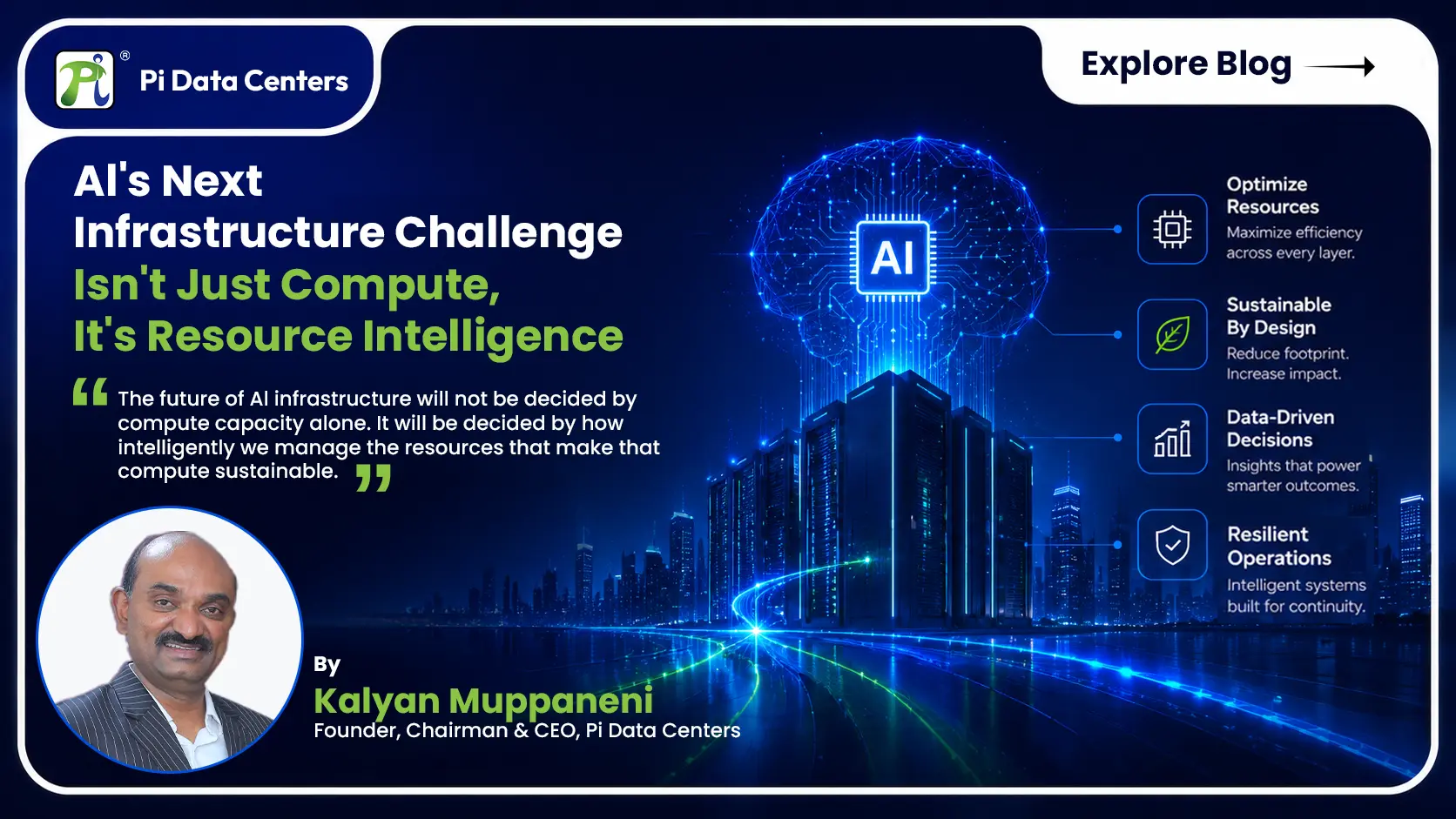
"The future of AI infrastructure will not be decided by compute capacity alone. It will be decided by how intelligently we manage the resources that make that compute sustainable."
Introduction
Over the past three decades, I've had the privilege of witnessing India's digital infrastructure evolve through multiple technology cycles. Every wave has redefined what the industry considered its biggest challenge. There was a time when connectivity dictated where digital businesses could scale. As cloud computing matured, the focus shifted to resilience, availability, and hyperscale capacity.
Today, AI is reshaping the conversation once again. While much of the industry's attention is understandably on GPUs, compute clusters, and power availability, I believe we are approaching another inflexion point, one where the long-term success of AI infrastructure will depend on how intelligently we manage the resources that support it.
In the years ahead, discussions around digital infrastructure will need to extend beyond megawatts and processing power to include water resilience, cooling innovation, and environmental sustainability as strategic business considerations.
"Infrastructure is no longer defined by what it consumes. It will increasingly be defined by how intelligently it manages finite resources."
From Resource Consumption to Resource Intelligence
This is not, at its core, an environmental conversation. It is an infrastructure conversation.
AI workloads are rewriting the economics of the data centre. Higher compute densities demand more sophisticated cooling architectures, which places a premium on efficient resource use. Water, as a result, can no longer be treated as a background operational input; it has to be planned for as a core piece of infrastructure design.
The real question isn't whether data centres consume water. It's whether they're engineered to optimise, recycle, and manage it responsibly across their entire lifecycle.
Organisations that recognise this shift early will build infrastructure capable of supporting AI at scale, while earning the confidence of regulators, customers, investors, and the communities they operate in.
Responsible engineering is fast becoming a competitive advantage, not a compliance checkbox.
Key Industry Shifts
The shift towards AI-ready infrastructure is gaining momentum across global markets. As organisations rethink how digital infrastructure is designed for the AI era, India is emerging as one of the key markets contributing to this transformation.
"The next generation of AI infrastructure should be designed for decades, not just deployed for today's demand."
India's Opportunity to Build Differently
India is uniquely positioned at this moment.
Unlike mature markets that are retrofitting decades-old infrastructure, we are building much of our next-generation AI and cloud ecosystem from the ground up, right now. That gives us something rare: the chance to make different choices from day one.
We can design infrastructure where intelligent cooling, resource-efficient operations, renewable energy adoption, and sustainable engineering are foundational principles, not future upgrades bolted on after the fact.
As India moves toward becoming a global AI powerhouse, our ambition shouldn't stop at building more data centres. It should be to build the world's most resilient, efficient, and future-ready digital infrastructure, proof that technological leadership and environmental responsibility can advance hand in hand, not in tension with one another.
India's Strategic Advantages
Looking Beyond the AI Boom
I believe the next generation of AI infrastructure will be measured not only by how efficiently it consumes resources, but by how effectively it protects and regenerates them.
Key Takeaways