



99.9%. 99.99%. 99.999%. These numbers are superficially associated with data centers whenever there is a contracting taking place. Enterprises read it, compare it across vendors, and sign based on it. That number is the Service Level Agreement (SLA). And it is, fundamentally, a promise on paper but with plethora of variables to orchestrate.
It tells you what the provider commits to. It tells you what happens financially if they fail to deliver it. What it does not tell you is how that uptime is actually achieved, or whether the infrastructure underneath the promise is engineered to keep it. An SLA is a commercial document. It is not an engineering guarantee. Hence it's important to understand each variable and stitch them together with resolution metrics for the promise on paper to be translated to on ground reality.
The enterprises those who have learned this distinction in the hard way are usually the ones who discovered it during an outage, when the SLA produced a service credit. However, the business had already lost the revenue, the compliance standing, or the customer trust that mattered far more than the credit ever could.
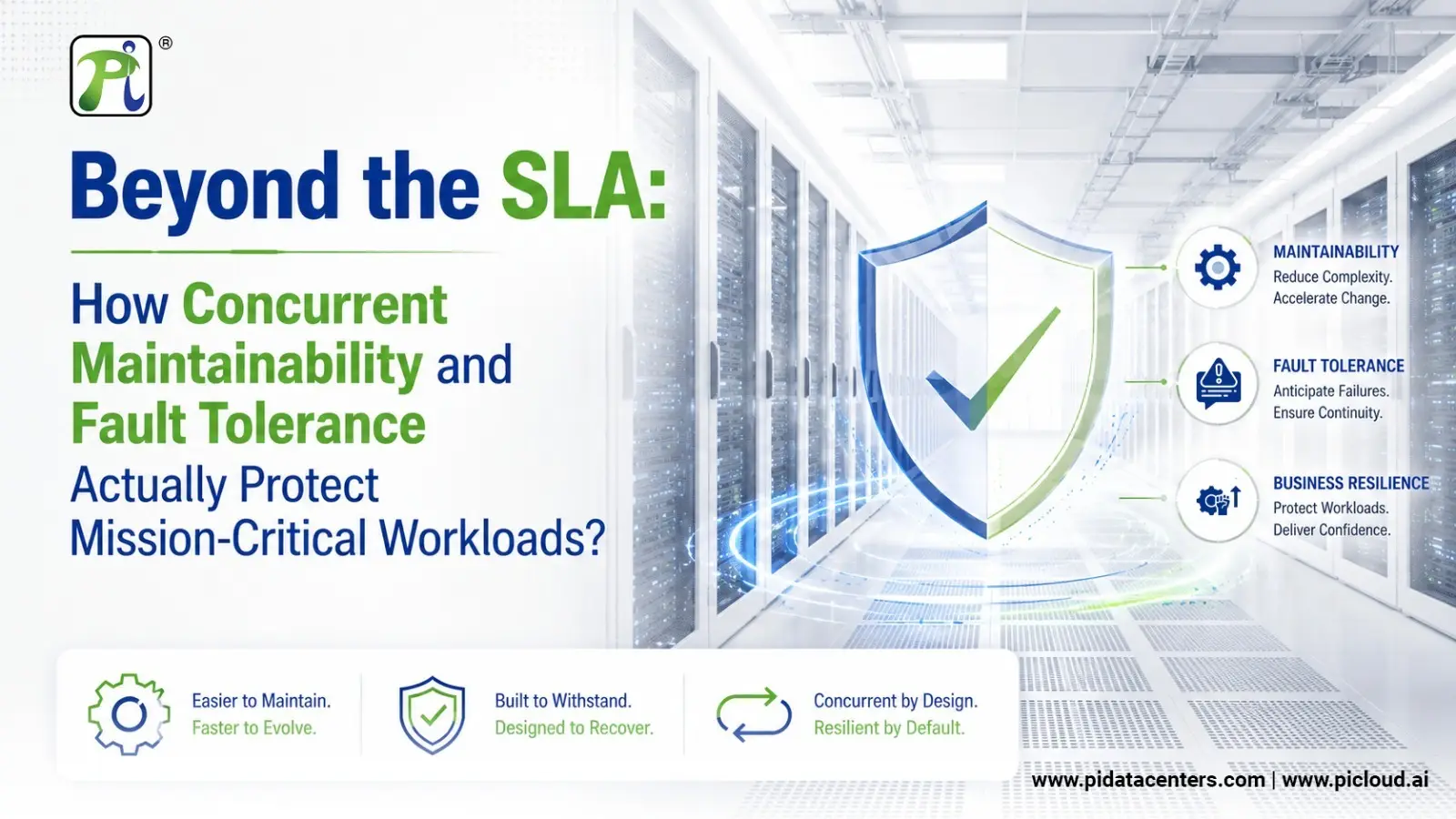
This is the gap between what a contract promises and what an infrastructure delivers. The two architectural principles which close that gap are concurrent maintainability and fault tolerance.
Every data center requires maintenance. Generators need servicing. UPS batteries need replacement. Cooling systems need inspection. This is not optional; it is an operational reality.
The question is what happens to your workload while maintenance is taking place.
In a facility without concurrent maintainability, maintenance requires a planned downtime window, a period during which systems are taken offline; redundancy is temporarily reduced, or risk is elevated while technicians work. Enterprises are told in advance, schedules are coordinated, and everyone hopes nothing goes wrong during the window.
Concurrent maintainability removes that risk entirely. It means every critical component in the facility, power distribution, cooling units, and network paths can be serviced, repaired, or replaced. In contrast, the facility continues operating at full capacity, with no reduction in redundancy and no risk to live systems.
Think of it as a four-engine aircraft where any single engine can be serviced mid-flight, while the other three carry the load, and the aircraft never has to alter its course. That is the standard concurrent maintainability holds infrastructure to.
For an enterprise, this means maintenance stops being a calendar event you have to plan around. It becomes invisible.
Concurrent maintainability addresses planned events. Fault tolerance addresses unplanned ones.
A fault-tolerant facility is architected so that when something fails unexpectedly, a power component, a cooling unit, or a network path is automatically and immediately taken over by a redundant system. No manual intervention is required to trigger the failover. There is no degraded performance during system recovery. The workload continues, and in a properly fault-tolerant environment, the business never even registers a failure.
This is the difference between infrastructure that is resilient by design and infrastructure that is resilient by hope, where redundancy exists on paper, but has never been tested under a real, unplanned failure event.
An SLA percentage is a statistical commitment. Concurrent maintainability and fault tolerance are architectural guarantees. One is a promise about outcomes. The other is the engineering that makes the outcome possible.
This distinction becomes critical when evaluating data center providers, because SLA percentages can be written into a contract regardless of whether the underlying infrastructure can actually sustain them. A 99.995% SLA on a facility without concurrent maintainability or fault tolerance is a number the provider hopes to hit not one the architecture is built to guarantee.
This is precisely why the Uptime Institute's TIER IV certification exists and why it requires two separate, independent audits, one for design and one for operational performance. TIER IV certification is the verification that concurrent maintainability and fault tolerance are not just present on paper, but operational in practice, audited by a third party with no commercial stake in the outcome.
For enterprises in BFSI, healthcare, and other regulated sectors, this is not an abstract engineering detail. A bank cannot explain a transaction failure to a regulator by pointing to an SLA service credit. A hospital cannot justify a delayed clinical system to a patient by citing a contractual remedy. In these industries, the infrastructure either holds or it doesn't, and the SLA document has no bearing on which it is.
The practical takeaway for any enterprise evaluating a data center or colocation partner is this: ask about the architecture before asking about the percentage.
Specifically, ask whether the facility has completed both design and operational TIER IV certification from the Uptime Institute, not "TIER IV equivalent," which indicates the facility has not been independently verified. Ask how maintenance is performed, and whether it requires any planned downtime window. Ask what happens, operationally, when a component fails unexpectedly, not what the SLA document says happens, but what physically happens to the workload in that moment.
The answers to these questions tell you far more about whether your infrastructure will actually protect your business than any uptime percentage ever will.
Pi Data Centers operates India's first Greenfield Uptime Institute TIER IV Certified facility, independently certified at both design and operational levels, meaning concurrent maintainability and fault tolerance are not aspirational claims but audited, verified operational realities.
This is the standard for mission-critical workloads which cannot afford downtime across industries such as BFSI, Healthcare, E-commerce, Retail, Government and other regulated sectors require, not a promise on paper. However, infrastructure engineered and independently verified to keep that promise, every day, without your business ever having to find out what happens when it doesn't.