



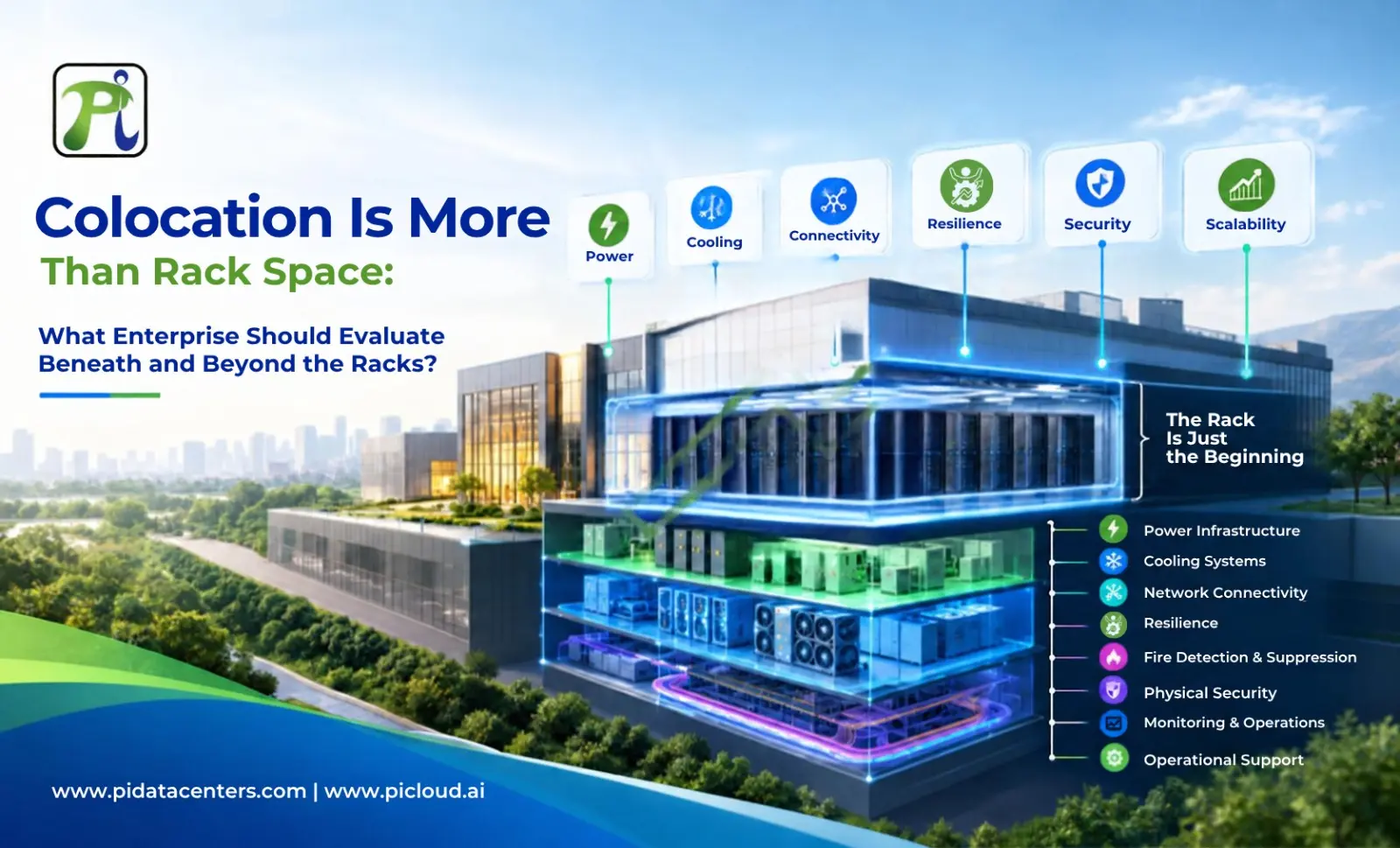
As enterprise workloads become more distributed, infrastructure decisions are increasingly being evaluated on availability, power density, connectivity, security and scalability, not simply on how much rack space a facility can provide.
This is where colocation becomes more than a physical hosting arrangement.
At its core, colocation allows organizations to deploy their IT infrastructure within a professionally engineered data center while retaining control over their servers, storage and network equipment. The facility provides the underlying environment required to operate that equipment reliably, including power, cooling, physical security, connectivity and operational support.
But for enterprise workloads, the quality of that underlying environment matters as much as the rack itself.
Two facilities can offer the same number of rack units while providing very different levels of resilience, operational control and scalability.
A colocation deployment typically begins with the IT equipment placed inside a secured data center environment. But the availability of those workloads depends on multiple infrastructure layers operating together.
These include:
Therefore, evaluating colocation purely on rack cost or price per U can overlook the infrastructure supporting that rack.
Power is one of the most important technical considerations in a colocation environment because every IT workload ultimately depends on electrical continuity.
A resilient facility typically uses multiple layers between the utility supply and the IT equipment.
A simplified power path can look like:
Utility → Switchgear → UPS → PDU → Rack → IT Equipment
Each layer introduces its own operational and failure considerations.
Data centers use different redundancy architectures depending on their availability objectives and design.
N+1 provides one additional capacity unit beyond the number required to support the load.
2N provides two independent systems, each capable of supporting the required load.
2N+1 combines independent redundancy with additional capacity.
For a colocation customer, the important question is not simply whether the facility claims to have redundant power. It is understanding where that redundancy exists and whether the customer's equipment can actually leverage independent power paths.
For example, dual-power-input servers can be connected across separate A and B power paths, allowing the equipment to continue operating if one path is unavailable.
As rack densities increase, cooling becomes increasingly important to infrastructure planning.
Modern processors, GPUs and high-density computing systems generate substantial heat. If thermal conditions are not maintained within the required operating range, equipment can experience performance degradation, thermal throttling or shutdown conditions.
Colocation facilities therefore need to consider:
For high-density workloads, the question becomes even more specific:
Can the facility support the required power density and remove the corresponding heat load?
This is why rack availability alone is not enough. A facility may have physical rack capacity but still require additional engineering to support higher-density deployments.
A data center can have highly resilient power and cooling, but connectivity remains a critical dependency for enterprise workloads.
Carrier-neutral facilities can provide access to multiple network providers, allowing organizations to select connectivity based on bandwidth, latency, geography, redundancy, and commercial requirements.
For enterprise deployments, network architecture should be evaluated across several dimensions:
This makes connectivity a strategic part of colocation rather than simply a utility.
Colocation involves placing valuable IT equipment inside a shared facility. Physical security therefore needs to extend beyond a locked building.
A mature security architecture can include multiple layers:
Perimeter security → controlled entry → identity verification → restricted data hall access → rack/cage access → surveillance and monitoring
Access controls can include biometric authentication, access cards, visitor management, and CCTV depending on the facility's security architecture.
For regulated and sensitive workloads, organizations should also evaluate access logging, auditability, security procedures and compliance requirements.
The objective is not simply to prevent unauthorized entry. It is to create an environment where physical access to infrastructure is controlled, traceable and appropriately restricted.
One of the most important considerations in colocation is understanding that resilience does not come from a single redundant component.
A resilient environment is created by eliminating or reducing single points of failure across interconnected systems.
Consider a simple dependency chain:
Power → Cooling → Network → IT Equipment → Application
If one critical dependency fails, the application can ultimately be affected even when the other systems remain operational.
This is why enterprise colocation assessments should examine the end-to-end architecture, rather than evaluating individual components in isolation.
Questions should include:
These questions provide a much clearer view of resilience than a simple uptime percentage.
For enterprises operating in regulated sectors, physical infrastructure must also align with internal controls and regulatory requirements.
Data center certifications and standards can provide evidence around areas such as:
However, certifications should be treated as one part of due diligence, not the entire evaluation.
Organizations should understand what a particular certification covers, which facility or design it applies to, and whether it aligns with the organization's own risk and compliance requirements.
A colocation strategy should not only answer:
"Where will we place our infrastructure today?"
It should also answer:
"How will this environment support the infrastructure we expect to deploy tomorrow?"
Enterprise environments can expand through additional racks, higher power densities, new network connections, additional storage and changing workload requirements.
A scalable colocation facility should therefore provide a clear path for:
Planning this upfront can prevent organizations from having to redesign their infrastructure strategy when capacity requirements change.
Colocation does not necessarily mean the customer must physically be present every time infrastructure requires attention.
Depending on the facility and service model, operational support can include activities such as:
For distributed enterprises, this can reduce the operational burden associated with maintaining equipment across geographically separated facilities.
The technical value is straightforward: physical infrastructure can be managed without requiring an IT engineer to travel to the site for every operational task.
Instead of comparing facilities primarily on price per rack, IT decision-makers should evaluate the complete infrastructure stack.
| Evaluation Area | Questions to Ask |
|---|---|
| Power | What redundancy architecture supports the IT load? |
| Cooling | What density can the facility support? |
| Connectivity | Are multiple carriers and diverse connectivity options available? |
| Security | How is physical access controlled and audited? |
| Resilience | Where are the potential single points of failure? |
| Scalability | Can capacity and power density increase as requirements grow? |
| Operations | What monitoring and on-site support capabilities exist? |
| Compliance | Which certifications and controls apply to the facility? |
| Location | Does latency and geographic positioning suit the workloads? |
| Interconnection | Can the environment connect efficiently to cloud, network and enterprise ecosystems? |
This shifts the evaluation from "How much rack space am I getting?" to "What infrastructure environment am I placing my critical workloads into?"
Colocation gives enterprises a way to retain control over their IT equipment while leveraging professionally engineered physical infrastructure.
But the rack itself is only the visible part of the equation.
Power architecture, cooling capacity, network diversity, physical security, resilience, operational support and scalability determine how effectively that rack can support business-critical workloads.
For IT decision-makers, the strongest colocation strategy therefore starts with a deeper question:
What has already been engineered beneath the rack?
Because when infrastructure becomes critical to the business, the quality of the environment around the equipment matters just as much as the equipment itself.