



In the first part of this series last week, I discussed why India’s rapidly expanding data-centre market is likely to move towards consolidation over the next decade. In this part I am sharing what makes an operator a durable and attractive platform to get acquired along with what the investors will be evaluating for consolidation.
The fact is that the underlying opportunity remains strong in India, the country will continue to require more data-centre capacity to continue digitalization, support cloud adoption, artificial intelligence, digital consumption, financial services, e-commerce and enterprise technology transformation.
However, a growing market does not guarantee that every operator will be successful in building a sustainable platform.
As competition increases, boards and investors will need to distinguish between capacity that has merely been announced and businesses that can generate durable and sustainable operating and financial returns.
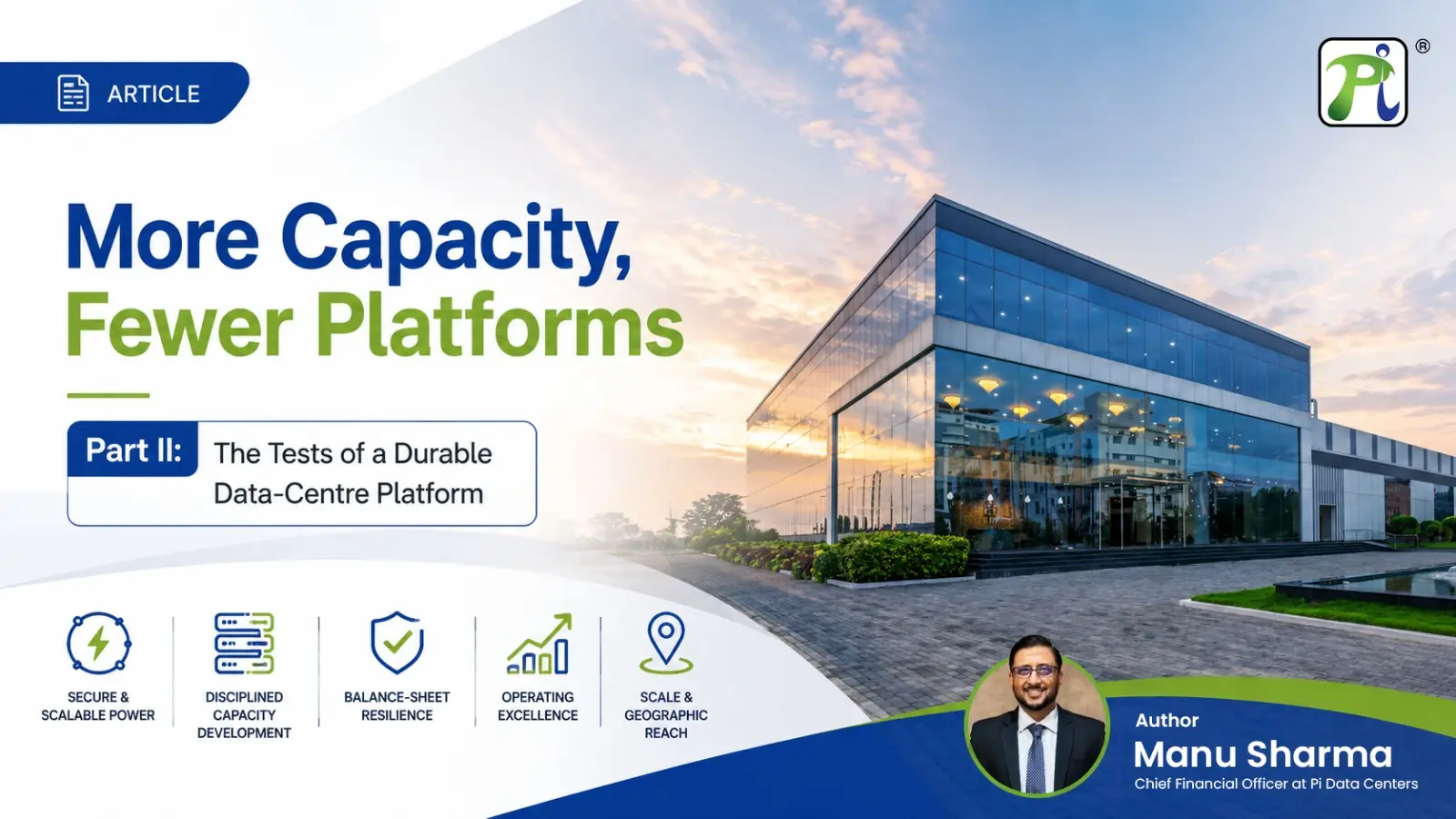
The strongest data-centre platforms over the next decade are likely to demonstrate five core capabilities.
Power is not simply an operating input for a data centre, It is one of the most important strategic constraints on growth.
An operator may have land, capital and customer interest, but without secure, reliable and scalable power, the platform cannot grow as planned.
Boards should assess whether power is available only for the current facility or whether it is also secured for future phases. They should also evaluate the commercial viability, reliability and sustainability of the power arrangement.
The critical question is not merely whether power has been applied for. It is whether power is available, scalable and aligned with the operator’s development schedule.
Data-centre capacity should be developed in phases and aligned with contracted or clearly visible demand. Building too slowly can result in missed customer opportunities on other hand building too aggressively can create underutilised assets, delayed returns and pressure on liquidity.
The quality of an operator’s development strategy can therefore be assessed through its approach to pre-commitment, customer visibility and phased capital deployment.
The strongest platforms will not necessarily be those announcing the largest capacity, instead they will be those that consistently convert new capacity into occupied and revenue-generating capacity.
Data centres require repeated investment over long periods. A facility may take years to develop, commission, contract and stabilise.
During this period, the operator must continue servicing debt, funding operating expenses and preparing for the next phase of growth.
This requires more than access to capital, it requires the right capital structure.
Boards and investors should evaluate whether the business can withstand delays in power, construction or occupancy without compromising the existing platform.
A company that can fund only the first phase is not necessarily capable of building a scalable data-centre business.
Data-centre customers do not buy only space and power, they buy reliability, security, uptime, responsiveness and confidence.
Operating excellence will therefore become one of the most important differentiators in a crowded market.
Operators will need to demonstrate consistent performance across uptime, energy efficiency, cybersecurity, compliance, maintenance and customer service.
A data centre is a mission-critical operating environment and the quality of operations will ultimately determine customer retention, reputation and the ability to win larger contracts.
Scale creates advantages in procurement, operating leverage, customer acquisition, technology investment and access to capital.
It also allows operators to meet the multi-location requirements of cloud, hyperscale and enterprise customers.
Subscale platforms may continue to operate successfully in specific markets or niches. However, those seeking to serve large national or global customers will increasingly need broader geographic presence and stronger execution capability.
Scale alone is not sufficient, in combination with operating quality, customer relationships and financial discipline, it becomes a significant competitive advantage.
The next phase of industry growth will also require a change in the metrics used to evaluate data-centre businesses.
Headline capacity announcements are useful indicators of ambition, but they do not provide a complete picture of business quality.
Boards and investors should focus on the quality, utilisation and cash-generating potential of capacity. For this the following questions are particularly important.
Announced capacity and operational capacity are not the same.
Operational capacity represents assets that have been commissioned and are capable of serving customers.
Contracted capacity provides visibility of future revenue.
Boards should also evaluate the quality, duration and concentration of those contracts.
Occupancy is one of the clearest indicators of commercial execution.
A commissioned facility without sufficient occupancy may continue to absorb capital without generating adequate returns.
The period between capital deployment and revenue generation has a material impact on project returns and liquidity.
Shorter and more predictable ramp-up periods indicate stronger execution and customer visibility.
Capex per announced megawatt is not enough.
Boards should understand the capital required to create an operational and occupied megawatt, as that is the point at which capacity begins to contribute meaningfully to financial performance.
Anchor customers provide valuable demand visibility.
However, excessive dependence on a small number of customers can create commercial and negotiating risk.
The financial model must remain viable not only after stabilisation, but also during construction and occupancy ramp-up.
Liquidity during this period is often as important as long-term profitability.
A data-centre platform should not be evaluated as a single project.
Its ability to fund future expansion without weakening existing operations is central to its long-term viability.
The next stage of the Indian data-centre market will be less forgiving than the previous one.
Capital will become more selective. Customers will prioritise proven operators. Investors will demand clearer paths to utilisation and returns.
The winners will be those that combine power access, disciplined development, customer visibility, operating excellence and balance-sheet resilience.
In the final part of this series, I will share my view on what consolidation will mean for the Indian data-centre industry—and why fewer platforms may ultimately create a stronger and more credible sector.