
☰

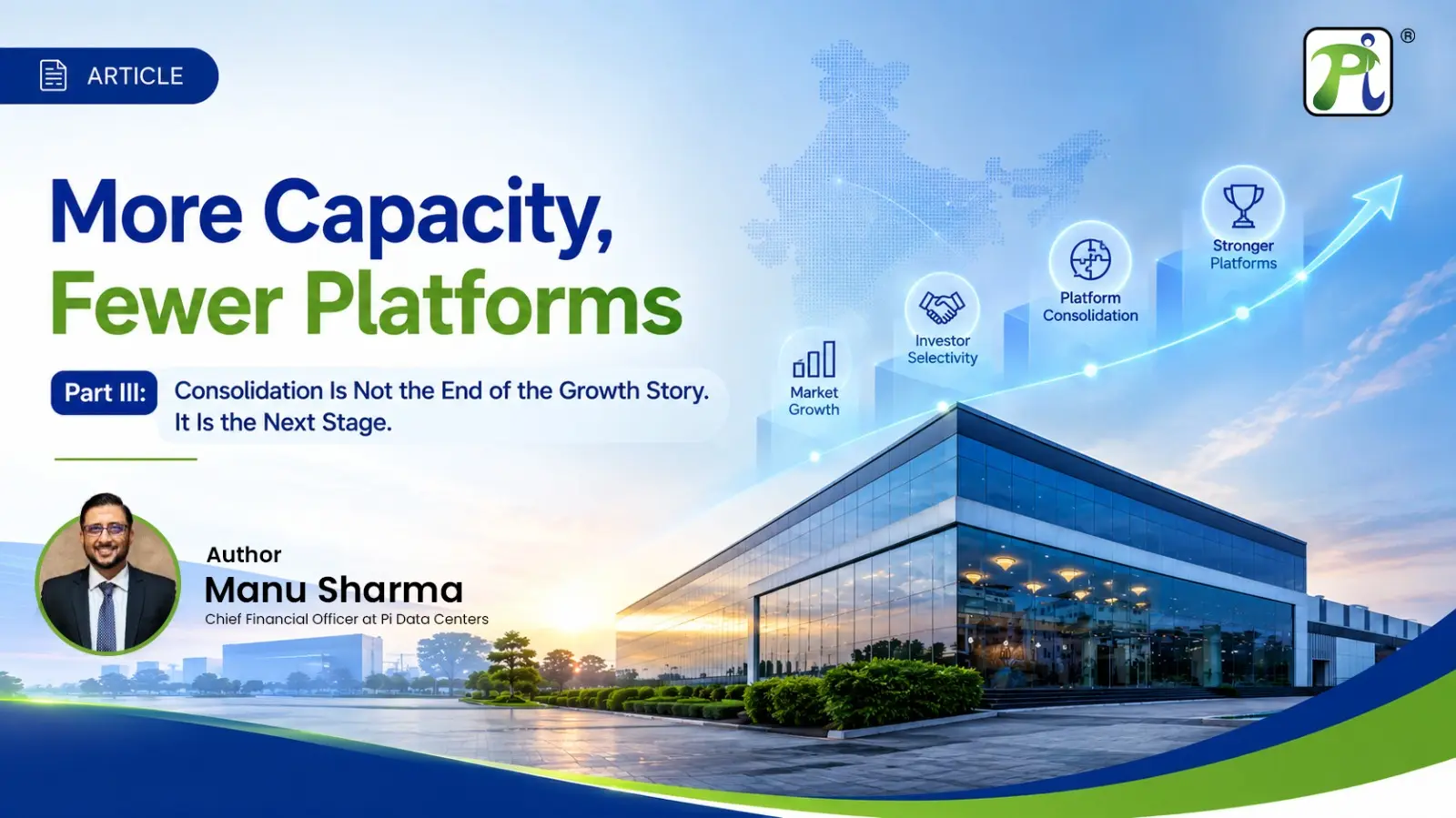
India could add several times today's data-centre capacity over the coming decade and simultaneously see the number of meaningful platforms decline. It is not at all contradictory to say that the industry will grow with significant growth in the underlying market and at the same time there will be consolidation among suppliers.
A growing market can still consolidate when scale, capital intensity, customer expectations and operating complexity begin to favour stronger and more resilient businesses.
I do not expect consolidation to arrive as one dramatic wave of acquisitions immediately or in the near future. It is more likely to evolve gradually.
Capital will surely become more selective and we will see that in the coming years expansion plans will slow down on weaker platforms. Strategic investors may enter at this juncture. Joint ventures and asset transactions could increase. Over time, platform-level consolidation will follow. Global operators may acquire local capabilities rather than build everything organically.
In many cases, consolidation may happen before the number of company names visibly declines. Some operators may end up selling individual facilities, others may bring in strategic investors, combine platforms or monetise land, power access or partially developed capacity.
For the last few years, the industry conversation has often centred around announced megawatts.
Going forward, capital itself may not be the scarcest resource. We have already discussed and seen that availability of high quality executable power will be the most scarce resource.
Bankable demand, executable power and the ability to convert both into cash-generating capacity may become far more valuable.
That is where I believe the real differentiation will emerge.
If I were building a platform today with a 10-year view, I would focus on these top five things:
This is the strategy that I would take as the strongest operators should not merely prepare to survive consolidation, they should be positioned to participate in it. This can happen only when you start building the balance sheet from now and keep looking for opportunities where high value revenue generating sustainable assets will be looking to be acquired for meaningful partnerships. It will be very important here to be prepared to be bitten by FOMO of acquisitions, for preserving liquidity to wait for the right opportunity.
My belief is that by the middle of the next decade, India will have a much larger data-centre industry—but a smaller group of genuinely scaled platforms. This is not at all concerning, as it would indicate that the industry has moved beyond the phase where announcements and planned capacity define success.
The next generation of leaders will be judged by something harder: how efficiently they convert capital into occupied capacity, occupied capacity into cash flow, and cash flow into sustainable returns.
India does not need fewer data centres. It may simply need fewer, stronger platforms operating them.
Fewer platforms don't mean a smaller industry. It means a more discerning one.
Read the full series: Part I | Part II | Part III